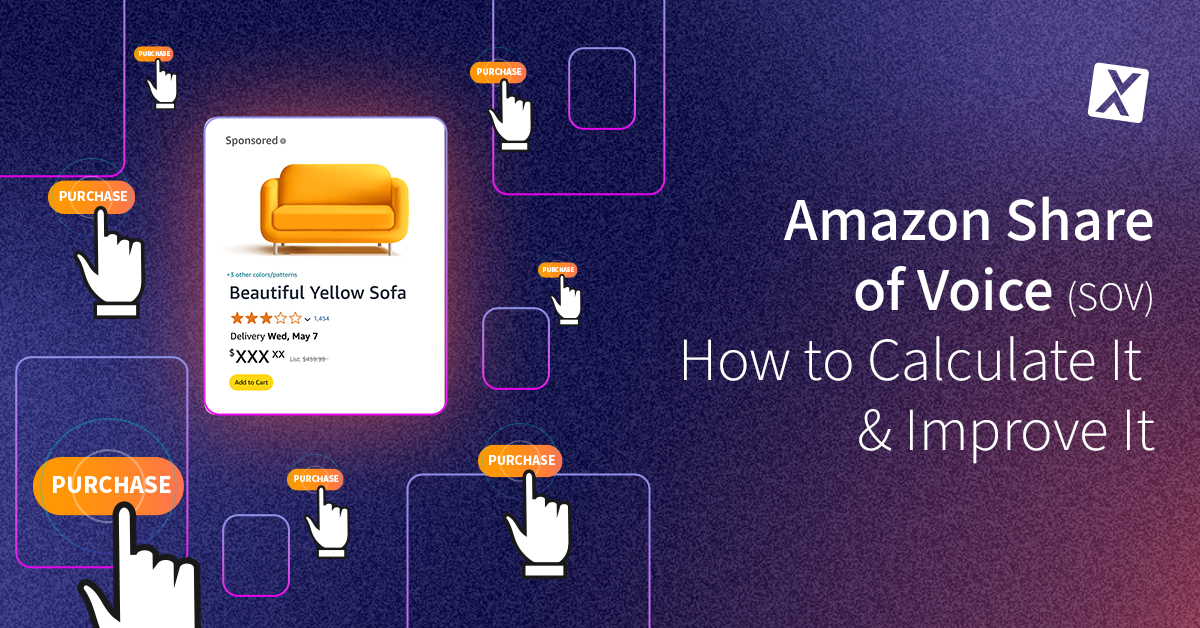
Amazon Share of Voice (SOV): How to Calculate & Improve It (2026 Guide)
In 2026, visibility is more than yet another metric for Amazon brands. When 70% of consumers purchase from the first page of search results, showing up there is a non-negotiable. Amazon Share of Voice (SOV) is the most reliable way to measure whether your brand is being seen where it matters most: in the moments shoppers are searching, comparing, and deciding to make a purchase.
At BidX, we believe the brands that win visibility shouldn’t have to sacrifice profitability or time. That’s why we empower eCommerce teams with transparent, performance-driven ad automation that replaces manual bid management so you have full control, clear insights, and scalable growth.
In this guide, we’ll cover what Amazon Share of Voice really means, how it’s calculated, and how to utilize Amazon’s newest SOV products. You’ll also learn why manual SOV management doesn’t work at scale and how automation can be a game-changer for brands operating across multiple campaigns, categories, and marketplaces. Let’s get started.
What Is Amazon Share of Voice (SOV)?
Amazon Share of Voice (SOV) measures how visible your products or ads are in Amazon search results compared to competing brands. It’s a percentage of the total impressions your listing captures within a given category, keyword set, or placement. Impressions are concrete, but SOV is relative. It highlights how dominant your brand is compared to the other advertisers competing for the same shopper attention.
Here are three breakdowns you’ll see:
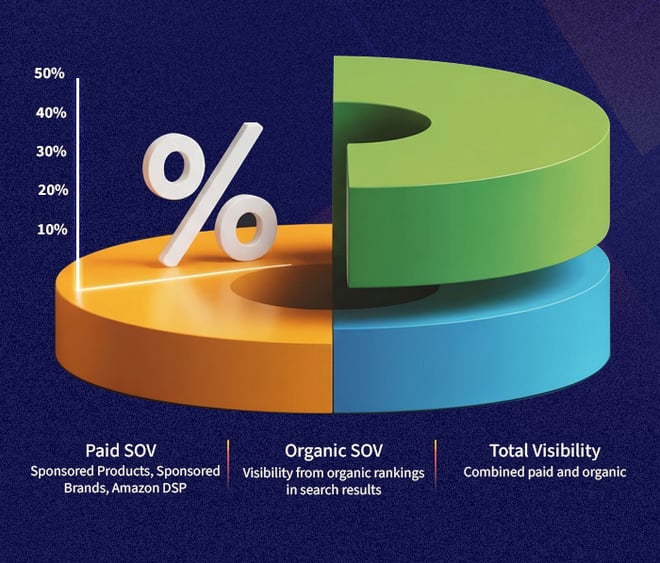
- Paid SOV includes visibility from Sponsored Products, Sponsored Brands, and Amazon DSP.
- Organic SOV shows visibility from organic rankings in search results.
- Total Visibility combines paid and organic to show your overall presence.
Amazon Share of Voice (SOV)
How visible are your products vs. competing brands?
Of course impressions can grow simply by increasing spend, but SOV stands out because it tells you whether that spend is actually winning. Multiple brands can earn similar impression counts, but only one will dominate the page. And when visibility drives conversions, SOV becomes the true measure of strength.
How Amazon Share of Voice is Calculated
Share of Voice is calculated with this formula:
SOV (%) = Your Brand Impressions ÷ Total Available Impressions
Share of voice
10,000 (%) = brand impressions x total available impressions
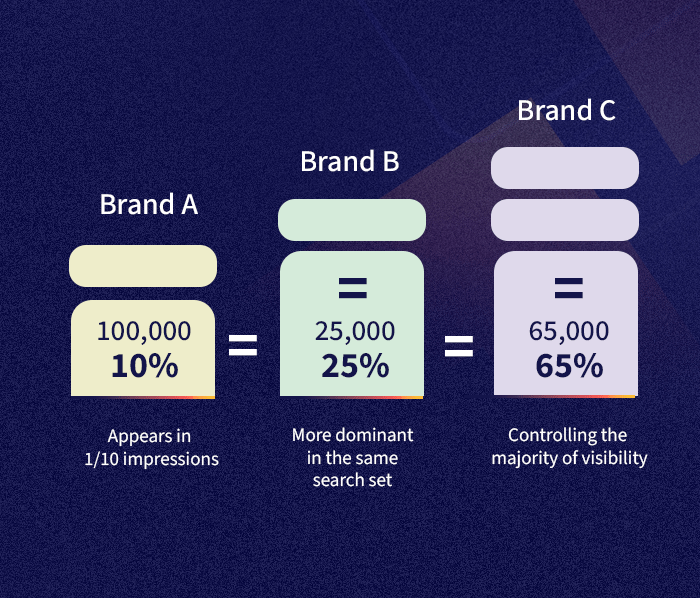
SOV becomes much more impactful when you break it down by segment. Each one tells a different story, and the way you measure it should match the outcome you’re trying to drive. Let’s walk through some segmentations:
|
Keyword-level vs. Category-level SOV |
Keyword-level SOV shows how your brand performs for specific search terms. Category-level SOV is more broad, showing your competitive positioning across an entire product set. |
|
Branded vs. Non-Branded SOV |
Branded SOV measures how well you defend your own name, while Non-Branded SOV shows how effectively you’re competing for new demand (and where competitors might be outspending you). |
|
Weighted vs. Non-Weighted SOV |
We know not all impressions are created equally. Weighted SOV assigns more value to premium placements like Top of Search, while Non-Weighted SOV treats all impressions the same. |
|
Top of Search Share of Voice |
Top of Search is the most competitive real estate on Amazon and also the most impactful. Brands can appear here frequently but still miss the moments shoppers actually click. Top of Search SOV helps explain why two brands with similar budgets can produce very different results. |
Amazon’s Official Share of Voice Products in 2026
Amazon offers a dedicated tool for guaranteed Top of Search visibility called Sponsored Brands Reserve Share of Voice. It provides predictable placement, fixed CPM pricing, and a clearer path to consistent exposure for specific keywords.
However, it’s important to note that this is only one tool in the SOV toolbox, not a full strategy. It can work well for product launches or short-term seasonal campaigns, but it doesn’t adapt to competitor actions, real-time auction dynamics, or daily budget pacing. So while it can guarantee visibility for the moments it covers, it doesn’t ensure consistent visibility throughout the day.
Why Share of Voice Matters for Performance
Amazon SOV is more than a reporting metric, it’s a performance signal. Sustained visibility drives sales velocity, especially in competitive categories where shoppers constantly see the same brands. Over time, that visibility can strengthen organic rankings, particularly for keywords where organic movement is slow. SOV is the best way to answer the questions that actually matter in a competitive market such as: Are we winning this category? Where are we most up against competitors? What level of visibility does our team actually need to maintain?
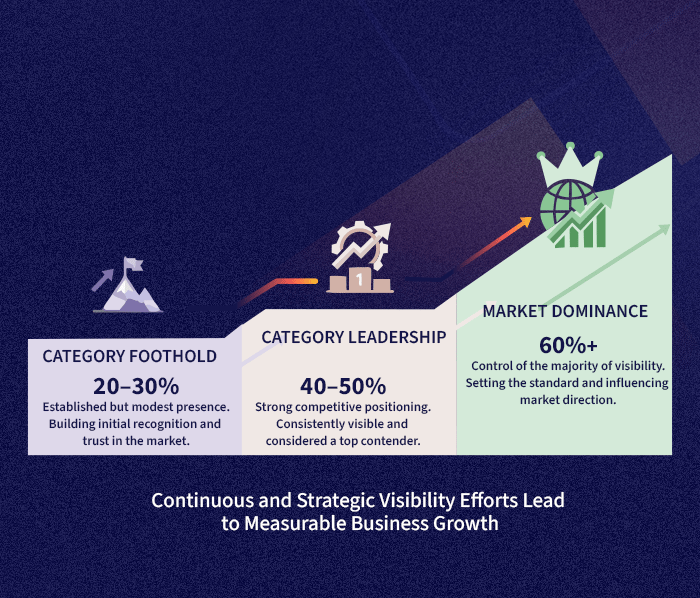
As for SOV targets, they will vary by category and maturity, but these benchmarks are a useful starting point:
- 20-30% suggests a solid holding
- 40-50% signals category leadership
- 60%+ reflects dominance in the space
The bottom line? SOV isn’t just visibility, it’s control.
What’s the Difference Between Share of Voice vs. Share of Shelf (SOS)
Share of Voice and Share of Shelf are frequently used interchangeably, but treating them as the same thing can lead to costly mistakes. Fortunately, the difference is simple.
- Share of Voice (SOV) measures paid visibility only.
- Share of Shelf (SOS) includes both paid and organic visibility.
Confusing the two can create false confidence or lead to overspending. A brand may see strong rankings in paid placements but still struggle to convert if organic visibility is low, and vice versa.
Brands that outperform consistently manage both metrics well. According to Trellis, brands with 20%+ SOV and 15%+ SOS in their category saw 2.7× more revenue than brands that had 10% in both metrics. This reinforces organic strength while maintaining paid visibility across marketplaces. SOV wins attention, SOS wins market share.
The SOV Efficiency Problem: Why Manual Control Breaks at Scale
Most brands don’t struggle with SOV because they don’t understand it, it’s because they try to manage it manually. Pulling levers and reacting to dashboards can work in a small set of campaigns, but it breaks down quickly as volume increases. When campaign counts rise, manual SOV control leads to predictable errors:
- Bid wars that inflate CPCs
- Budgets exhausting early, often by midday
- Reactive optimizations that chase visibility after it’s already lost
- Split decision-making across markets and teams
At scale, manual control becomes not just inefficient, but a competitive disadvantage. This is where automation changes the game. Rather than reacting after visibility drops, automation adjusts bids dynamically based on competiton, manages budgets throughout the day, and maintains target SOV levels over time. Automation keeps your brand visible without burning budget or relying on the need for someone to keep trying different levers.
Sustained Visibility Drives True Performance
|
Manual Control |
Automated Control |
|
Starts strong in the morning |
Automated bidding |
|
Drops sharply after budget exhausts |
Maintained SOV throughout the day |
|
Spikes when team reacts |
Dynamic bids and pacing |
|
Drops again |
Consistent visibility over time |
How Automation Changes SOV Management
If you’re an agency managing handfuls of accounts, SOV is a metric that tells a narrative clients will appreciate. But manual bid adjustments and chasing visibility once it’s lost isn’t productive for anyone. It can quickly go through budgets and offset actual performance results.
Enter: BidX. Our automations fast-track execution, allowing agencies to maintain category presence proactively. BidX enables teams to scale without needing headcount as the software is analyzing and adjusting based on real-time performance and competitive pressure.
Your team can still deliver visibility oversight to clients, just without having to do the handholding. Now agencies can protect branded terms, defend category presence, and demonstrate proactive performance management — all without doing the heavy lifting. Automation makes SOV controllable at scale, which is exactly the problem BidX is built to solve.
European & Multi-Market SOV Complexity
European sellers have faced SOV complexity for years. The UK, DE, FR, and ES marketplaces each have different CPC dynamics, competitive sets, and visibility costs. So strategies that work in one market often fail in another.
Copy-pasting campaigns across regions or categories creates predictable problems: overspending in low-competition markets, inconsistent reporting, and under-exposure in high-pressure auctions. This leads to inconsistent visibility and growth.
Multi-market SOV management is crucial but requires centralized oversight paired with local adaptability. Manual workflows struggle to maintain that balance well. To control visibility across multiple categories or regions, brands need a centralized automation that can scale without needing someone constantly monitoring the dashboard.
Advanced SOV Tracking (AMC & Beyond)
For advanced advertisers, Amazon Marketing Cloud (AMC) opens the door to deeper Share of Voice analysis, especially when visibility needs to be tied back to real business outcomes. AMC moves teams beyond basic SOV snapshots and provides a more strategic view of visibility over time. With AMC, you can analyze:
- Visibility trends over time, showing how competitive pressure evolves in categories
- The relationship between SOV, ROAS, and conversion rates instead of each metric living in silo
- Long-term category movement, explaining whether gains in visibility are temporary or sustainable
That said, AMC isn’t a requirement for every brand. The right level of SOV tracking depends on your organization, campaign volume, and decision-making needs. More data only creates value when it leads to clearer, faster decisions, not just another dashboard to manage.
Practical Takeaways: When to Act on Share of Voice
Amazon Share of Voice comes down to intentional visibility. The right level of control depends on how important that is to your growth strategy and bandwidth. The goal isn’t to spend more, it’s to control visibility with intention in a way that drives performance.
Signs your brand should actively manage SOV:
- Visibility is a key driver of category leadership or defense against competitors
- Competitors regularly appear above you for priority keywords
- Branded terms require frequent protection
- Performance fluctuates based on time of day or budget pacing
- You need visibility to be a control lever, not another metric
Manual control can be “good enough” when:
- Campaign volume is limited
- Spend levels are low
- Competition is stable or predictable
- You operate in a single marketplace or category
Automation turns SOV into a control system
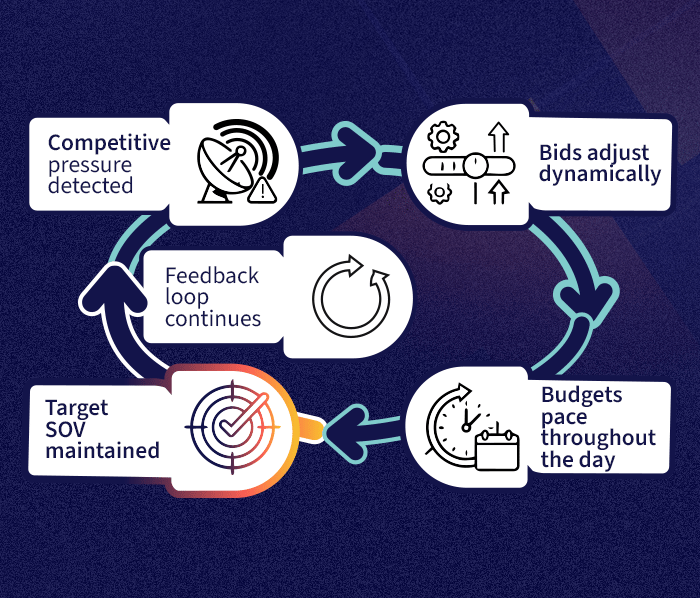
If you’re managing dozens of campaigns at the same time, need visibility across markets and categories, and notice budgets are gone by 2 p.m., SOV automation is a non-negotiable.
What’s Next to Maximize Amazon Share of Voice?
Before increasing spend, the most productive next step is to audit your current SOV data set. See where SOV gaps exist, consider how consistent you can maintain visibility, and whether your approach can realistically keep pace as competition and campaigns increase. It can make all the difference when it comes to earning SOV that moves the needle and keeps you ahead of the competition. Ready to get started? We’re here to help!
When Active SOV Management Becomes EssentialRecognizing these triggers empowers you to optimize your advertising investment and competitive standing. |
|
|---|---|
 |
Managing multiple campaigns or categories. Simultaneously overseeing diverse initiatives demands precise allocation and tracking. |
 |
Budgets exhaust early in the day. When funds are depleted prematurely, missing peak-hour opportunities and losing share. |
 |
Operating across regions or marketplaces. Expanding presence requires adapting strategies for distinct geographical and platform dynamics. |
 |
Visibility tied to category leadership. Maintaining a dominant market position necessitates continuous, proactive visibility strategies. |